
By Jeff Kapembwa
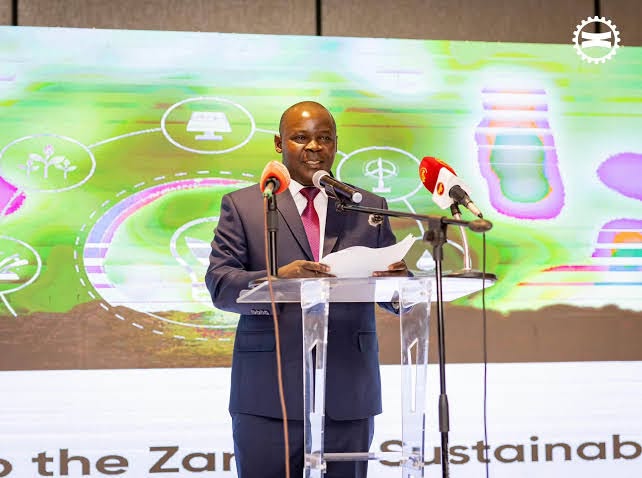
Zambia’s inaugural US$100 million sustainability bond issuance by the private sector ignites plans by the Southern African state to actualize the ‘Grow agenda’ and insulate against El Niño induced headwinds, Minister for Green Economy and environment, Gilbert Siame, says.
‘Blue Chip-Lusaka Bourse listed, Zambia National Commercial Bank (ZANACO) Plc, in collaboration with the British Investment Institute (BII), joined hands in launching a two-phased instrument, Wednesday, to foster a private sector-driven economic blueprint.
The issuance to be actualized in two phases, with the first US$50 million expected to disbursed in the immediate, the first sustainability medium term unit, is arguably to raise resources through the bourse as a development fund, will help the country’s transition to a Green economy.
Driven by the private sector, the instrument, when subscribed, will drive energy and agriculture growth and bolster other growth sectors. It will further help mitigate and insulate against climate change as envisaged under the 9th National Development Plan, stunted by public debt and other headwinds.
Minister Siame noted that the joint effort to mobilise long-term capital was a great innovation by the private sector which should be emulated as the country embarks on a Grow Zambia Agenda and broaden growth.
Officiating at the issuance of the medium-term instrument in Lusaka, Dr. Siame said the initiative by the private sector was a direct challenge on the Government to streamline all bureaucratic policies that delay economic growth and create room for similar investment that generates both financial returns and measurable environmental and social protection.
“It demonstrates what can be achieved when government policy, private-sector innovation, financial markets and development partnerships come together around a common development objective,” he said, while challenging the private sector to join hands with Government to ‘reclaim economic losses spurred by various factors.
“The action by the Bank (ZANACO) is a direct challenge to us as Government and other players in the private sector, and it goes to show that we need to review all policies that frustrate economic growth, tell us where the problem is; if it is policy, let’s identify the problem and the New Dawn Government will act.”
Under the Zambia Growth agenda, the Government has mooted an ambitious strategy, in pursuit of economic growth that creates employment and investment opportunities for the people. It also seeks to protect our natural environment, strengthening resilience to climate change and ensuring that development is sustainable and inclusive.
Under the Eighth National Development Plan (8th NDP), environmental sustainability, economic diversification and social inclusion are at the centre of the country’s agenda. Zambia has strengthened the framework through the Green Economy and Climate Change Act No. 10 of 2024.
The framework is vital for climate-change adaptation, disaster-risk reduction, low-emission development, carbon markets, environmental and social safeguards, and the establishment of the climate change fund.
Zambia, Dr. Siame stated, has devised the Zambia Green Financing Taxonomy, providing a framework for identifying economic activities that make a meaningful contribution to 3 climate-change mitigation and adaptation, water security, biodiversity protection, pollution prevention, sustainable resource use and the circular economy.
The frameworks are important because sustainable finance must be more than a label. It must result in capital being directed towards projects and economic activities that are credible, transparent, measurable and aligned with Zambia’s national development priorities.
Justifying the sustainability bond issuance, ZANACO Chief Executive Officer Mukwandi Chibesakunda the inaugural instrument is a yardstick for raising capital, with proceeds expected to support climate resilience, economic growth and social development in Zambia.
The US$100 million medium-term note programme is an impetus to shift the financial institutions’ commitment to providing sustainable finance towards execution.
She defended the bank’s action saying it would create financing opportunities for farmers seeking to strengthen their resilience to climate change, entrepreneurs and small and medium-sized enterprises (SMEs) looking to expand, as well as communities in need of critical social infrastructure.
The initiative was particularly important amid growing climate-related risks facing Zambia and other parts of the world that need insulation.
According to the Bank’s blueprint, the proceeds from the instrument will help finance climate-smart agriculture, renewable energy, energy efficiency, financial inclusion for SMEs and critical social infrastructure as envisaged under the bank’s policy of “You First”.
“At ZANACO, our purpose is anchored on our You First philosophy. It is a commitment that places our customers, communities and our country at the centre of every decision we make,” she said.
British International Investment (BII) Managing Director and Head of Africa Chris Chijiutomi was elated with the bond placement, as the transaction aligned with BII’s new five-year strategy, which stresses strengthening the local financial system.
“One of the priorities of our new strategy that we launched this year is to help strengthen local financial systems and mobilize more private capital,” Chijiutomi said.
Development finance institutions such as BII are vital in providing investment, but greater mobilisation of private capital is also necessary to expand development financing in economies such as Zambia.
British High Commissioner to Zambia Rebecca Terzeon said the transaction demonstrated the UK’s shift towards an investment-led approach to development partnerships.
Ms Terzeon said BII’s investment in ZANACO’s sustainability bond showed how UK-supported development finance could be combined with Zambian institutions to support commercially viable investments while delivering development outcomes.
“This is exactly what the UK means when we talk about donor to investor,” Ms Terzeon said, referring to the mobilisation of finance to help businesses grow, create jobs and strengthen Zambia’s economic resilience.
Lusaka Securities Exchange (LuSE) Chief Executive Officer Nicholas Kabaso said the issuance marked a new chapter for Zambia’s capital markets and described it as the first sustainability bond issued by a Zambian bank.
Mr Kabaso said the exchange would work with stakeholders to develop a pipeline of future thematic bond issuances, simplify the issuance process and standardise reporting and verification requirements.