
By Jeff Kapembwa
Zambia and the Food Agricultural Organisation are cautious of the effects and vulnerability to climate shocks of its agrifood system with the forecast Super El Nino and are talking to necessitate and avail US$300 million to insulate and avert hunger.
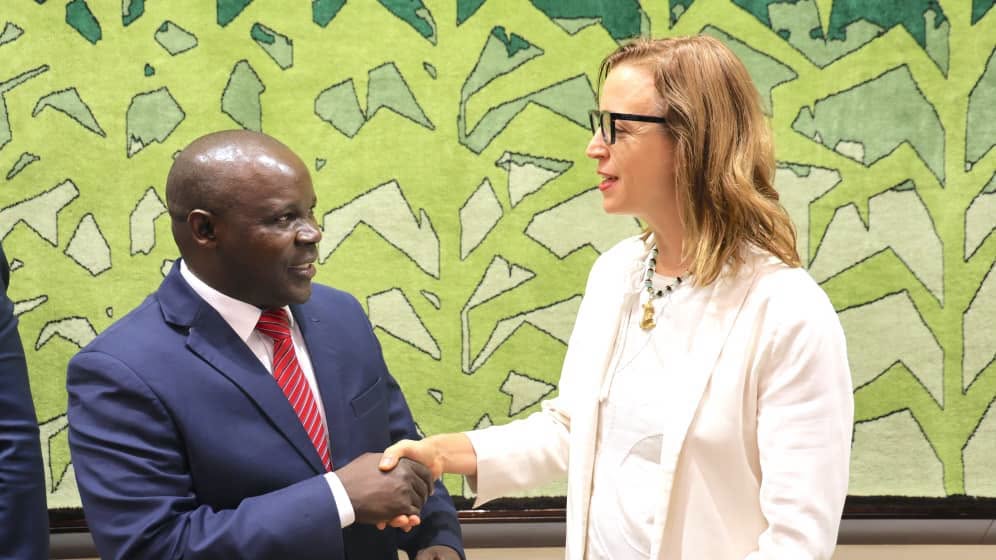
Zambia’s Minister of Green Economy and the Environment, Gilbert Siame and the UN food agency’s Deputy Director of the FAO Office of Climate Change, Biodiversity and Environment and Piedad Martin, on the sidelines of the ongoing FAO Hand-in-Hand Investment Forum agreed to jointly pursue and secure the climate finance and transform the agrifood system in Zambia.
Attracting among others, Jeff Griffin, Executive Coordinator of the Global Environment Facility (GEF); Sergio Hinojosa, Natural Resources Officer at GEF; Michela Morese, Senior Energy Team Lead; and Fouad Bergigui of the GEF Small Grants Programme.
The meeting was to ensure stop-gap funding was mobilized to climate-proof Zambia’s agrifood systems and enhance resilience across agricultural value chains.
The high-level bilateral side meeting held ahead of the official opening of the annual food indaba Minister Siame reaffirmed the Government’s commitment to leveraging climate finance to transform agricultural production while advancing sustainable economic growth.
“We have secured high-level collaboration to advance Zambia’s climate financing agenda and climate-proof our agrifood systems.” Minister Siame said, while aligning the potential success to FAO’s influential hand.
“ Through partnerships with FAO and international climate finance institutions, we are positioning Zambia to attract investment that strengthens agricultural production, creates opportunities for our farmers and builds resilience against climate shocks,”
Zambia is anxious over the funding as the initiative aligns with the country’s much touted ‘green growth’, recognising that investments in climate action and agrifood systems are mutually reinforcing.
Zambia is showcasing climate-smart investment opportunities across the maize, wheat, beef, soybean and honey value chains, alongside renewable energy solutions that support agrifood development as part of the investment agenda.
Ms Martin underscored the importance of climate finance in accelerating sustainable development, describing it a good catalyst.
“Climate finance is an essential catalyst for transforming ambition into action. Zambia has presented a compelling vision that brings together climate resilience, sustainable development and agricultural growth.” she said, adding:
“FAO looks forward to supporting the Government and its partners in developing investment-ready initiatives that can unlock climate finance at scale and deliver lasting benefits for communities, ecosystems and the economy,”
FAO Representative in Zambia, Suze Percy-Filippini, underscored the importance of transforming agrifood systems in addressing food security and nutrition challenges. Transforming Zambia’s agrifood systems is critical to achieving food security, improving nutrition and creating economic opportunities across rural communities, but needs resilience.
“By investing in resilient agricultural production, stronger value chains and inclusive market systems, Zambia is laying the foundation for sustainable agrifood systems that can feed a growing population while creating jobs and improving livelihoods. FAO remains committed to supporting the Government in advancing this important agenda,”
At another forum, water and sanitation ministry Permanent Secretary Romas Kamanga said Zambia was desirous to increase investment in water sector security, infrastructure and climate resilience through Italy’s Mattei Plan for Africa, a statement from the ministry reads.
During a meeting, Kamanga reaffirmed Zambia’s interest in leveraging the Mattei Plan to attract investment in strategic water projects that support national development priorities and sustainable economic growth.
Zambia was formally included among the Mattei Plan’s partner countries in March 2026.
According to the terms, the initiative seeks to promote mutually beneficial partnerships between Italy and African countries through investment and cooperation in key sectors, including water, energy, agriculture and infrastructure.
The Plan aligns with Zambia’s Grow Zambia Agenda, which seeks to accelerate economic growth through increased production and investment in productive sectors such as agriculture, energy and mining, Permanent Secretary said during a One Water Summit – Euro-Mediterranean Water Forum in Rome.
Reliable water supplies, modern water infrastructure and climate resilience are essential to achieving these ambitions. Zambia is expected to showcase its Water Investment Programme (ZIP), alongside other priority, investment-ready projects, for consideration under the Mattei Plan and relevant Italian financing mechanisms.
The Ministry of Water Development and Sanitation remains committed to pursuing strategic partnerships and innovative financing mechanisms to expand water infrastructure, enhance climate resilience and contribute to Zambia’s broader economic development agenda.
Earlier, Eng. Kamanga reiterated Zambia’s efforts to mainstream the Water-Energy-Food-Ecosystems (WEFE) Nexus approach into national development planning and regional cooperation.
Zambia has adopted the approach through existing national policies, planning processes and multi-sectoral coordination mechanisms, rather than establishing a separate institution.
He noted that the 2021 National WEFE Nexus Dialogue helped strengthen collaboration among stakeholders in the water, energy, agriculture and environment sectors.
The approach has since been reinforced through policy instruments, including the National Green Growth Strategy 2024–2030.
He stressed the relevance of the WEFE Nexus to the Grow Zambia Agenda, noting that ambitions to increase agricultural production, expand energy generation and accelerate economic growth require integrated and sustainable management of water, energy, land and ecosystems.
At the regional level, Zambia continues to leverage existing platforms such as SADC, ZAMCOM, the Lake Tanganyika Authority and the Zambezi River Authority to promote cooperation on shared water resources.