
By Jeff Kapembwa
Interest groups advocating for Africa’s food sovereignty have converged in Lusaka to share ideas and strategise on how the continent can maximise the agricultural sector’s potential by improving agrifood systems and becoming food secure amid climate change and other headwinds.
The Comprehensive Africa Agriculture Development Programme (CAADP), jointly with Action Aid and Care International urges Non-State Actors in collaboration with respective Governments, to domesticate the Kampala Declaration, 2025-2035, a successor to the 10-year Malabo Declaration, which ended last year.
Zambia is one of the countries that signed the operationalisation of the African Union’s 23-year-old policy framework for agricultural transformation, wealth creation, food security, and nutrition, seeking to boost investment in agriculture and increase food production.
This, is envisaged to reduce hunger through sustainable, inclusive growth, targeting 6% annual growth in the sector, is a flagship for Africa’s self-reliance amid various headwinds.
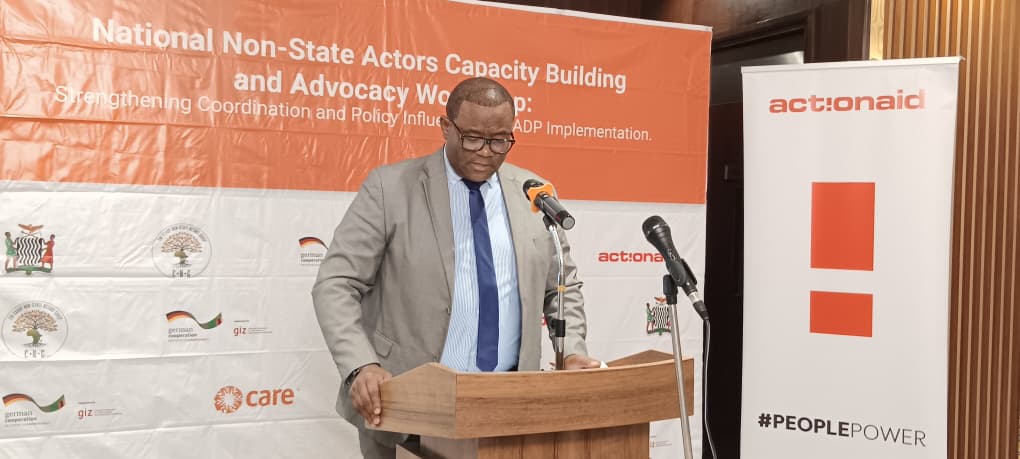
The Ministry of Agriculture’s Permanent Secretary, John Mulongoti, officiating at the meeting, urged the non-state actors to partner with the Government in enhancing the actualisation of the Malabo Declaration, a cornerstone for enhancing the CAADP, Africa’s agricultural transformation agenda since the Maputo Declaration was signed in 2003.
In a statement read on his behalf by Oscar Chita, director at the ministry, Mulongoti said the indulgence of the non-state actors in embracing CAADP was pivotal in mitigating climate change, market volatility, rising food prices, and increasing nutritional insecurity, affecting agrifood systems.
“These challenges disproportionately affect smallholder farmers, women, youth, and vulnerable households, who form the backbone of our agricultural economy.” he said at the national workshop on strengthening NSA coordination and advocacy in CAADP implementation.
Zambia was desirous to create linkages with NSA and other interest groups on the backdrop of the country seeking to bolster food production with maize targeted to increase to 10 million tons by 2031, produce 1 million tons of wheat and 1 million tons of soya beans as it aspires to become Africa’s food basket.
“These targets are not merely aspirational. They are strategic national priorities aimed at ensuring food security, enhancing export earnings, and promoting industrialisation”
Care International, Country Director, Chikwe Mbweeda stressed the need for co-existence with the NSA, cooperating partners, among others in ensuring targets set become part of the effort to actualise CAADP at national levels.
This forms part of the strategy to ensuring food security, enhancing export earnings, promoting industrialisation through value addition, and positioning Zambia as a regional food basket. The attainment of the targets require collaboration between and the NSA a timely strategy.
Noting the challenges facing smallholder farmers, women, youth, and vulnerable households, a backbone of our agricultural economy, NSAs need to support the Kampala Declaration, a vehicle in championing a shift towards integrated resilient and market-oriented agrifood systems.
Noting the strong policy and investment framework challenges faced by NSAs, it was imperative that the interest group’s potential be adequately harnessed to enhance actualisation of the sector transformation which should be fully integrated into planning, budgeting, implementation, and monitoring processes.
She encouraged NSAs to take centre stage than hang in the Periphery, arguably to enhance sector transformation and that can be fully integrated into planning, budgeting, implementation, and monitoring processes.
Ms Mbweeda recognised the Government’s quest to domesticate the commitments through the implementation of the comprehensive agriculture transformation support programme, serving the country’s national agricultural investment plan.
Embracing and supporting CAADP was cardinal as it was aligned to vision 2030 and the eighth national development plan, focused on agricultural transformation, productivity enhancement, value addition, and market integration.
Under the framework, government prioritises strategic investments in irrigation development, farm mechanisation, access to finance, research and development, agro-industrialisation, and strengthening regional and international trade linkages.
And the CAADP Non-State Actors Group (CNG), an agricultural transformation group on the continent, seeking to enhance participation of civil society organisations, farmers, youth and women, in policy formulation, while promoting sustainable and resilient agri-food systems, supported the call for the inclusion of the grouping in actualizing CAADP ideals.
This is evidenced by calamity caused through El Nino induced drought that afflict countries including Zambia during the 2023-24 season and affected millions of people and reducing maize production, our national staple, a call for such interventions.
“For many Zambians, agrifood systems are not just a policy conversation — they are a daily lived reality.” said Chikondi Chabvuta, the CNG Chairperson.
CNG, while seeking to align and support the transformation to enhance agrifood system calls for inclusion of people to share ownership of the process, a call for strong coordination — across government, civil society, the private sector, and communities — not as separate efforts, but as aligned and reinforcing actions.
Through the Kampala Declaration on CAADP, Africa has reaffirmed a vision for agrifood systems that are resilient, inclusive, and responsive. CNG is here to support Zambia in advancing that vision.