
By Jeff Kapembwa
The Annual World Bank and International Monetary Fund driven spring meeting opens today in Washington DC with the Bretton Woods institutions expected to redefine the effects of climate change and the reigning conflicts by some of the world’s major countries, fueling concerns of economic slowdown for most members of the two institutions.
The meeting dubbed: “Building Prosperity Through Policy” and focusing on policy reforms, global economy and strategic responses will seek to devise strategies that support jobs, unlocking private investment, addressing structural challenges and climate vulnerability.
The Spring meeting which runs from 13-18 April has an onerous task of finding lasting solutions to the impact of climate change on the economies of member states, particularly regarding financial resilience, debt sustainability, and the transition to a low-carbon economy.
The meeting which has attracted ministers of finance and their central Bank Governors, among other key players in the world order will further strive to navigate shifts in geopolitics, trade and technology-what with the surging war between Israel aided-United States and Iran war.
According to a tentative programme, the Spring meeting will centre discussions on managing the economic fallout of climate change, posing an existential threat to growth and financial stability.
It will look at fiscal and financial risks with the International Monetary Fund seeking to mainstream climate-related risks into macroeconomic policy advice, specifically addressing debt sustainability in developing countries, particularly in Africa, which face high risks of stranded assets.
The meetings will seek to examine the near-term macroeconomic implications of decarbonization policies, acknowledging that while transitioning to a cleaner economy entails costs, delaying action will be far costlier to GDP.
The Civil society and partners-all Non State Partners are poking the IMF to institutionalize mandatory climate impact assessments.
This, they seek, should be aimed at all lending programs and are expected to ensure that policies do not worsen environmental or economic stability, specifically highlighting, for example, cases where past programs inadvertently encouraged fossil fuel expansion.
The meeting will seek to advance the call for Adaptation and Mitigation Financing which need to be redressed through mobilizing public and private finance.
This is seeking to support countries in achieving their Nationally Determined Contributions (NDCs), especially for low-income countries that face higher volatility and lower adaptive capacity.
Vulnerability of countries and regions has taken its toll on growth and climate change has been cited as the key contributor for retardation of affected economies. It is alleged to have downsized income convergence and widening inequality in such countries.
It chiefly affected Sub-Saharan Africa and other vulnerable, low-income areas. The 2026 meetings are considered critical for aligning financial surveillance and lending with the long-term climate goals of member states.
The IMF-World Bank Spring Meeting will act as a base to resolve the unfolding natural rupture in the world order dubbed a “a harsh reality…where geopolitics…is subject to no limits, no constraints.”, according to Canadian Prime Minister Mark Carney’s descriptive analysis.
Last January, Prime Minister Carney, warned of Violations of international law, from Israel’s genocide in Palestine, to teh illegal abduction of Venevuela’s president, teh economic strategulation of Cuba and teh war launched on Itan and Lebanon.
These, he contended reflect significant changes in approach by the United States – the largest and veto-holding shareholder of the Bretton Woods Institutions (BWIs, i.e. IMF and World Bank) – to maintain its hegemony over a shifting global economic order.
The neoliberal policy framework long promoted by the BWIs appears to be reaching its limits – the cumulative outcome of decades of policies that have shaped the current global economy.
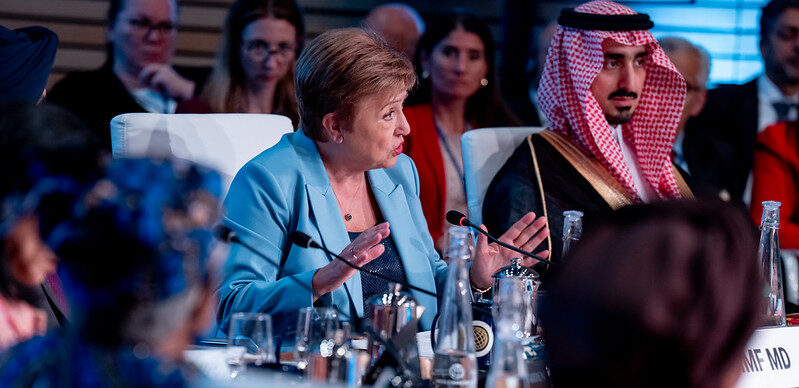
IMF’s managing Director-Director Kristalina Georgieva regretted that the ongoing conflicts in the Middle East is a test case as the conflict has caused considerable hardship around the globe, a call for global reaction to mitigate the shock and ease the pain on economies and people.
A supply shock that is large, global, and asymmetric she notes needs urgent redress. She notes as a result, the world’s daily oil flow cut by some 13 percent, and its LNG flow by some 20 percent.
Brent jumped from $72 per barrel on the eve of hostilities to a peak of $120, forcing people to now start paying more for energy and with supply chains disrupted across the world.
“The supply interruptions have had—and will for some time continue to have—ripple effects.
The World Bank adds its weight on the call to fight climate change through its blueprint: “Climate Change Action Plan 2026–2030,” emphasizing the transition from setting pledges to achieving measurable impacts on greenhouse gas reductions and adaptation.
The World Bank, during the meeting, sought to dangle its 2026-2030 climate strategy, lobbying the world to migrate from “greening” individual projects to “greening” entire economies. It focuses on implementing sustainable, renewable energy systems.
It supports and is advancing the Mission 300 Partnership, a joint initiative with the African Development Bank to provide electricity to 300 million people in sub-Saharan Africa by 2030. The Bank aligns it with both economic development and climate goals.
The lender is committed to allocating 45% of its financing to climate-related projects, with a strong emphasis on scaling adaptation finance to help developing countries build resilience to natural disasters.
There is greater need to leverage private sector investment to meet the required $2.4 trillion needed in annual climate investment by 2030 in developing countries, less China.
There are plans by the institution to connect its Country Climate and Development Reports (CCDRs) directly with Country Partnership Frameworks (CPFs), ensuring climate strategies are embedded into all development operations.
The Bank however, faces resistance from civil society users of fossil fuel despite moving toward renewables. The campaigners want fossil gas (liquefied natural gas) from its “Mission 300” and other energy investments. Campaigners want complete a total phase-out of fossil fuel financing.