
By Jeff Kapembwa
Haunted by recurring food loses on the continent-estimated at US$4 billion, capable of feeding 48 million African inhabitants, efforts have been stepped up to invest in the production, distribution, among other technologies to ensure food security.
Food security Campaigners-Alliance for a Green Revolution in Africa (AGRA), an African-led partnership working across the continent to support small-scale farmers and the United Nations Food agency-FAO have stepped in and are working with smallholder farmers on how to curb the loses on the continent under threat of food securing for among other reasons climate change.
Research findings show that the food loses (Post Harvest Loses) in the Sub-Saharan Africa have escalated in recent years-estimated at an average 23 percent annually, far above the average global score of 13.3%.
The high PHLs attributed to poor food management and outdated food storage and harvest methods have become costly for the continent.
This is, chiefly on account of among other reasons-climate driven crisis-including poor soil fertility-prompting some governments to partner with the private sector and invest in modern management policies and technology.
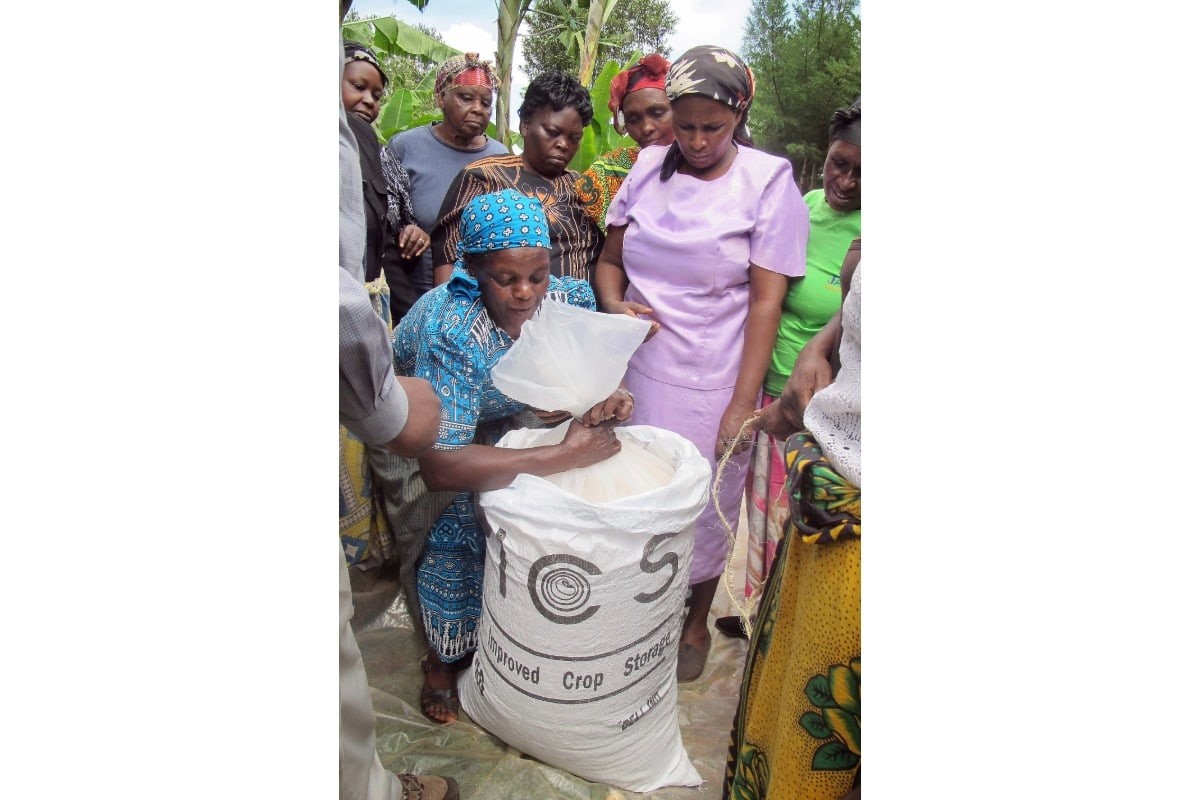
The use hermetic storage technology such as the Purdue Improved Crop Storage or “PICS” bag, developed by Purdue University in West Lafayette, Indiana, US.
The bags are sustainable and resilient against loses and affordably low, and is accessed by millions of the region’s small-holder grain producers as a measure to curb the PHLs.
The bags are comprised of three disconnected plastic layers. The inner two layers are made up of high-density polyethylene material, 80 microns thick. The outer third layer is a standard polypropylene woven sac, with all the linings remaining.
It is however, “detached from one another and are individual, separate layers that offer sustained grain safety,” according to the International Crops Research Institute for the Semi-Arid Tropics (ICRISAT) of the standards of the material made of.
The multi-layered bag technology “modifies the environment and restricts gas exchange with the outside atmosphere,” according to Technologies for African Agricultural Transformation (TAAT).
The agency is funded by the African Development Bank and tasked to increase the continent’s agricultural productivity through the deployment of proven and high-performance agricultural technologies.
“Under this system, farmers can store grains for up to two years while retaining their palatability and cooking quality,” it said, adding “grain quality is conserved through the regulation of moisture inside the bag and inhibits fungal growth that leads to build-up of carcinogenic mycotoxins.”
“The cooking time of grains preserved in hermetically sealed bags remains the same as freshly dried ones whereas loss of moisture in traditional storage techniques may double the amount of time and energy that is needed for preparing grains as food,” TAAT said.
Reports from the food meeting in the US, say the investment is an initiative by farmers and other interest groups to pacify over the looming food crisis.
This is ensuring adequate food volumes and the resilience of smallholder farmers in tackling agricultural challenges such as climate change and commodity price volatility are attained.
It cites, among other regions, West and East Africa where food insecurity has increased by 21% and 17%, respectively, over the past year, the report says citing the United Nations World Food Programme (WFP).
This trend has triggered concerns among public and private sector food industry players about the slow implementation of sustainable measures to increase food production and embrace better post-harvest management practices.
The heightening PHLs on the continent raises concerns of potential food shortages and could raise demand for the majority 3 billion populace.
Across SSA, with an estimated population of 1.3 billion people, there are projections of food demanding tripling by 2050. PHLs, especially in grains, have been singled out as a major problem that undermines the region’s food security and reduces earnings for smallholder farmers.
Sub-regional PHLs are estimated at more than 30% of the total harvest, largely attributed to poor storage infrastructure, inadequate technology and farmers’ limited skills on post-harvest losses.
This has prompted affected governments to shift from traditional storage methods-use of regular bags and silos whose performance is compromised by pest infestations and spoilage.
And AGRA), says PHLs in Africa are a critical crisis, estimating about 30–40% of agricultural output wasted annually during harvests due to poor infrastructure, limited storage, and inadequate processing.
The campaigner emphasizes that these losses threaten food security and farmer incomes, calling for investments in climate-resilient technologies.
Inadequate storage, poor handling practices, limited access to affordable preservation technology, and underdeveloped value-addition infrastructure are among the reasons.
The losses, AGRA cite as a significant, multi-billion dollar hit to the continent’s economy and reduce farmer incomes.
It calls for increased adoption of hermetic storage bags and mechanized threshers, as some of the post-harvest technologies to curb loses.
AGAR is championing among other projects, REGAIN (Scaling Solutions for Food Loss in Africa) are being implemented to test and scale climate-resilient technologies and practices.
The RE-GAIN (Scaling Solutions for Food Loss in Africa) initiative is a multi-country program championed by AGRA and supported by the Green Climate Fund (GCF) to reduce post-harvest food losses and boost climate resilience.
It aims to deploy affordable, practical technology—such as hermetic storage bags, solar dryers, and, for example, moisture meters—to smallholder farmers across seven nations (Burkina Faso, Ethiopia, Kenya, Malawi, Tanzania, Uganda, and Zambia).
Some schools of thought contend climate change has had a greater impact on PHLs in Africa as it creates warmer, more erratic weather conditions that accelerate food deterioration, foster pests, and disrupt storage infrastructure.
Rising temperatures and humidity levels degrade food quality faster, with roughly 14% of the world’s food lost between harvest and retail.
It is estimated that by 2050, a 10% increase in postharvest loss could boost fresh produce costs by 14% and increase hunger risk by 11%. Economically, over $400 billion worth of food is lost annually between harvest and retail, with climate factors exacerbating these damages.