
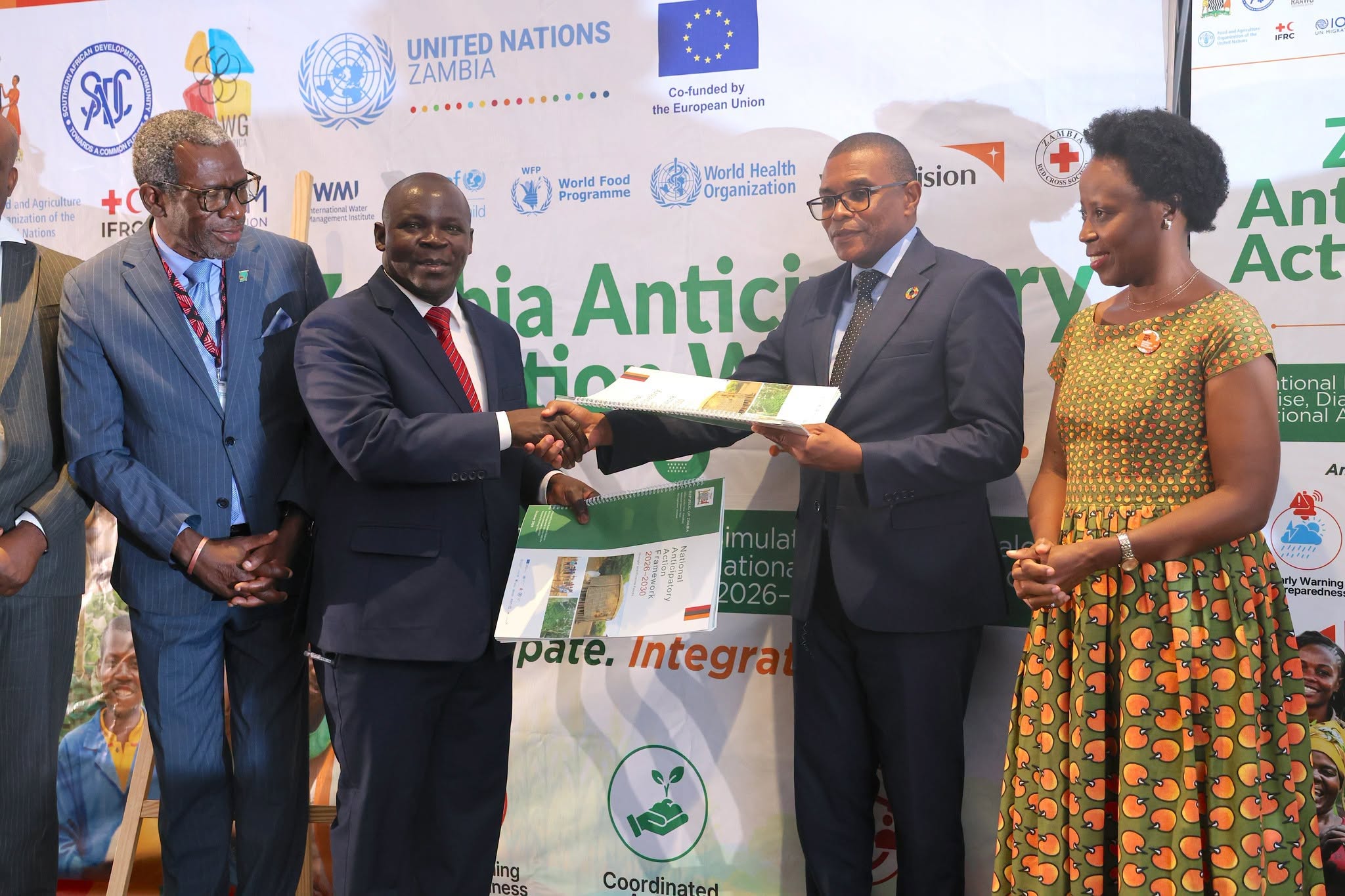
By Jeff Kapembwa
REELING from the climate effects endured during the 2023-24 farming season, that reversed national economic gains spurred by El Nino induced climate effects, Zambia has launched a 2026-2030 National Anticipatory Framework.
The launch, the first in the Southern African region is anticipated to insulate the Southern African state from temperature driven headwinds as it transitions into industrialisation.
The four-year-anti-climate change insulation initiative, devised with support by the European Union is further envisioned to help strengthen the country’s disaster preparedness, reduce vulnerability, chiefly among communities, many who are victims.
The framework is chiefly initiated to protect communities from the increasing impacts of climate related hazards and other shocks the country embarks on actualising the ‘Grow Zambia Agenda-a revitalisation programme, seeking to revamp the economy maximising on the untapped potential endowed potential in energy, agriculture, water and other growth sectors.
The precaution entails the 20-million populated state taking precautions to avert potential El Nino induced drought and other disasters unlike reacting, a cost, the country incurred.
This, prompted authorities to ‘ask for aid from the international community to pacify over effects incurred in 84-of the country’s 116 districts, leaving over 9 million people hungry and a further 3 million children malnutritious.
Vice President Mutale Nalumango, in launching the strategy in Lusaka, Friday, justified the remedial action, founded on a transformative principle of acting ahead of a potential hazard unlike reacting, after damage has occurred and affected the economy and the communities.
“When we act early, we can significantly reduce human suffering. When we act early, we minimise economic losses. when we act early, we protect our development gains.” The Vice President said in statement read by Minister of Green Economy and Environment, Dr. Gilbert Siame.
Unpredictable weather patterns induced by El Nino has exhibited potential effects on rainfall patterns in the country, leading to prolonged dry spells, drought conditions, crop failures, water shortages, food insecurity and adverse economic impacts, noting that prospects of the 2026-27 season falling prey are looming as exhibited by climatic indicators.
The Government, seeks urgently operationalise the framework to test its capability to cushion the likely effects of El Nino on the country’s ecosystem.
He urged technocrats to urgently actualise the framework given the weather forecasts indicating a high likelihood of the El-Nino-related impacts during the current rainfall season, government looks forward reference document as outlined in the guide action, support decision making, and ensure that vulnerable communities receive assistance before disaster impacts escalate.
The Vice President called for collective effort to propel the framework, a humanitarian gesture is to ensure the success of the framework as it was fundamental to the actualisation of the ‘Grow Zambia Agenda’.
Zambia is using it abd it as yardstick to revitalise the economy until 2031 is hinged on promoting economic transformation, food security, job creation, climate resilience and sustainable development, hence the call to cushion.
“Climate-related shocks have the potential to erode development gains, undermine investments, reduce productivity, and increase poverty and vulnerability. Anticipatory action is, therefore, not only a humanitarian necessity, but also a development imperative.”
She challenged all line ministries, various stakeholders to join hands in ensuring the framework was achieved as espoused with communities being the centre of benefitting from the initiative.
She noted that the success of the project would be measured by its impact on safeguarding the people, the environment and overall, the ecosystem.
Mrs. Nalumango assured the EU-Civil Protection and Humanitarian Aid Operations (DG-ECHO), the United Nations agencies, civil society groups that contributed resources to ensure the operationalisation of the framework, of Government’s resolve to ensure the framework was supported and its forecast achievements upheld and sustained in the interest of the communities.
“Zambia remains fully committed to strengthening resilience and enhancing national preparedness for disasters and climate-related risks.”
United Nations Acting Zambia Country Coordinator, James Wakiaga commended Zambia in collaboration with various partners for initiating and launching the framework which will help determine the country’s preparedness to remain resilient to climate and other related risks, noting that the county remains vulnerable as evidenced by the weather indicators.
He called for a shift from reacting to disaster management by being cautious before they strike, chiefly in areas vulnerable to disasters.
“This requires clear triggers, agreed actions and financing that can be released quickly. The Ready Set-Go approach translates this into three practical steps: prepare, monitor and act. Early warning,
However, it only protects lives and livelihoods when information reaches people in time and in a form they can understand and act upon. Community radio, mobile phones, traditional leaders, extension officers and volunteers are therefore essential to turning early warning into early action.” He said.
While anticipatory action is ideal to undertake, there is urgent need for longer-term investments in climate resilient agriculture, irrigation, water management, livestock, diversified livelihoods, markets and social protection.
These investments, collective can protect production, incomes and jobs while strengthening community resilience and advancing the Grow Zambia Agenda. Your Honour, Distinguished Ladies and Gentlemen.
The UN envisions that the capabilities of the framework launched would be test during the planned simulation exercise as the National Anticipatory Action Dialogue Platform provide an opportunity to test arrangements, address gaps and clarify responsibilities from national to community level.
The ongoing Return on Investment and Indigenous Knowledge studies will also provide valuable evidence to guide future investment.
“Zambia has an opportunity to protect its development gains, strengthen resilient food systems and safeguard the livelihoods and economic opportunities central to the Grow Zambia Agenda.” Dr. Wakiaga said.
He reaffirmed the UN’s commitment of the United Nations system and development partners to working alongside the Government and people of Zambia to translate this ambition into concrete action. I thank the Government and all partners for their leadership and commitment.
Disaster Risk Management Division (DRMD) National Coordinator, Norman Chipakupaku, emphasized the importance of translating early warning information into timely, coordinated and evidence-based action to protect lives, livelihoods and development gains.
And speaking at the same occasion Regional Anticipatory Action Working Group (RAAWG) coordinator, Talent Manyani commended Zambia for its unwavering effort to remain resilient against climate change, a feat yearned by neighbours in the region and beyond.
“Zambia has done it. On Monday you had a drought. On Tuesday, a flood. On Wednesday you sat in one room and said honestly what needs fixing.
“Today you are debating it in the open, and tomorrow you launch. Most of us write a framework and put it on a shelf. Zambia wrote one and then tried to break it before the launch. Colleagues, that is not normal. That is leadership.”