
By Jeff Kapembwa
Africa’s self-determination lies in the creation of a climate Innovation Compact Fund unlike aid dependence to tackle 1,000 African solutions—buffeting growth sectors and advancing Pan-African prosperity, notes host Ethiopia.
The creation of the sustained fund, to be hinged on partnerships by all climate campaigners-local and foreign, will be a springboard for the continent’s resilience to devise home-made-mechanisms that will entrench climate data sovereignty, mapping our own forests, measuring our own carbon, and pricing own ecosystems.
The withdrawal of the United States from the Paris Agreement, has left a yawning gap for Africa, like other continents to fight ravages of drought, unprecedented heat waves, drying rivers, among other calamities that need funds to mitigate and adapt and save the planet.
Estimates show that the US was the largest donor towards climate change under the Paris Agreement. Its share to the global climate change fight included increasing international public climate finance to $9.5 billion in fiscal year 2023, with plans to reach $11.4 billion annually by 2024 and 2025,
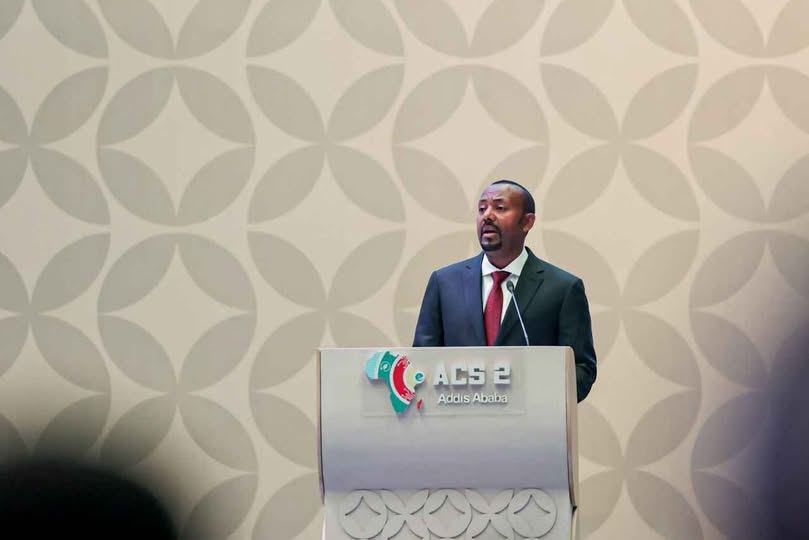
Addressing the Africa Climate Summit which opened in the capital, Addis Ababa, Ethiopian Prime Minister, Abiy Ahmed, defended the creation of the multi-purpose Compact that will harness the potential endowed on the continent and help downtrodden communities by 2030 and beyond.
Dr. Ahmed told delegates attending the continent’s second climate conference dubbed: “Accelerating Global Climate Solutions: Financing for Africa’s Resilient and Green Development.” called for unity of purpose by all interest groups in tackling climate change through a self-owned initiative that will drive innovation for durable and lasting climate solutions and entrench sovereignty.
“This Compact will be funded and owned by Africans – in partnership with the world, but never beholden to it.” He noted, adding:
“By 2030, the Compact should aim to deliver 1,000 African solutions—to tackle climate challenges in energy, agriculture, water, transport, and resilience. We will also claim climate data sovereignty—mapping our own forests, measuring our own carbon, and pricing our own ecosystems. “
It was inevitable for Africa to innovate and plan its destiny in fighting the recurring climate change headwinds but remain steadfast and ensure programs mooted unite universities, research institutions, startups, rural communities, and motivate innovation and foster trade growth beyond borders.
Determination for Africa to resuscitate its own economies should be the driving force and the clarion call for its self-determination. There is dire need to replace climate aid with climate investment through promotion of data science to resolve Africa’s own crisis, given the milestones made in various countries.
“Africa should be the place where the world sees climate goals achieved where reforestation is not a pilot project but a culture, where climate-smart agriculture feeds millions, and where green corridors connect cities and rural areas in a shared economy of life.”
On the call for co-existence Dr. Ahmed urged global partners not to ‘fund us’ (Africa) despite being impacted, but to invest since its impact, but to invest with the people who are visionary, though unable to maximize its potential.
We have the solutions to restore degraded land, to capture carbon, to produce green and clean power. We know what needs to be done. Now is the time to scale what works. Now is the time to accelerate our collective action. This is not charity. It is the most strategic investment humanity can make.”
He underscored Africa’s determination to emerge stronger out of the climate impact and allow the afflicted rivers, air and other aspects once all people appreciate the predicament and devise workable solutions.
It was imperative for Africa to make the right choices and devise a path to the continent’s desire to industrialise without destroying the eco-systems adding: “If we make the right choices now; Africa can be the first continent to industrialize without destroying its ecosystems.”
Africa Union Commissioner, Fitsum Assefa commended Ethiopia for landmark initiatives to insulate against climate change. He urged all countries to emulate Ethiopia and shape the continent’s ambitions to become a pipeline and in turn, investment backed by sound policy and strong partnerships.
Assefa reminded delegates about the gravity of the climate impasse and work towards shaping an African decade of delivery on various programmes.
He urged the second climate conference to showcase Africa climate solutions, mobilize finance at scale, and turn our natural endowments, human capital and innovation ecosystems into shared prosperity.
“The second climate summit is where we commit to do these things together with speed, at scale, and with integrity.”
Kenya, the first host of the African Summit showcased various strides undertaken at the summit that helped to reduce climate change effects in the country with a vision focused towards green industrialization, value addition, inclusion and resilience.
President William Ruto reminded the delegates of the various commitments made during last year’s conference among others; attaining 300 gigawatts of renewable energy by 2030 as a show of self determination.
This was never just an energy target. It was an economic strategy. A strategy to place Africa at the forefront of the modern economy, where climate ambition fuels investment, competitiveness, and sovereignty.
He reminded the continent that despite various efforts, there remains various investments fragmented, too few are scaled, yet regional value chains remain fragile to compete, a call for collective action to change the untapped potential in various sectors into reality.
He reiterated the call for integration and collaboration with well-meaning partners
“Africa’s strength lies in integration and in collaboration with partners who share our vision. No country can build competitive industries or value chains alone. ” the Kenyan leader said, but with determination.
“But united – with our financial institutions, our energy systems, our trade corridors, and with partners working in solidarity with us – we can anchor inclusive and globally competitive green value chains.”