
By Jeff Kapembwa
The surging climate change impacting countries and the planet, calling for insulation against the crisis has prompted Zambia to launch a ‘Green-self-financing model’, making it one of the African states advancing climate-resilient, nature-positive and low-carbon development.
Zambia, like many African countries, victims of climate change are grappling with mitigation and resilience against the science induced variations in temperatures-threatening global warming.
Under the Paris Agreement, countries are consistently urged to implement comprehensive strategies that both mitigate climate change (reduce emissions) and adapt (build resilience) to its impacts.
These two approaches are considered equally urgent and necessary for long-term survival.
Despite the low financing from key polluters, the United States, Japan, India, among others, low income countries within Africa, Zambia included, are grappling to raise resources to counter the recurring effects on the environment and humanity.
The United Nations estimates say, Africa received approximately $15 billion in adaptation finance in 2023, while needing at least $70 billion a year, highlighting a significant financing gap.
In 2021/2022, total climate finance to the continent was around $44 billion, with $19 billion coming from Multilateral Development Finance Institutions (MDBs), and private sector finance reaching $8 billion, but it’s a quarter of the estimated needed annual clean energy transition funding of $200 billion.
Developed countries’ contributions are insufficient and often come as loans, with a failure to meet previous financial commitments to developing nations, a wakeup call for self-initiated master plans to maintain green economies, which Zambia aspires to attain through home grown initiatives.
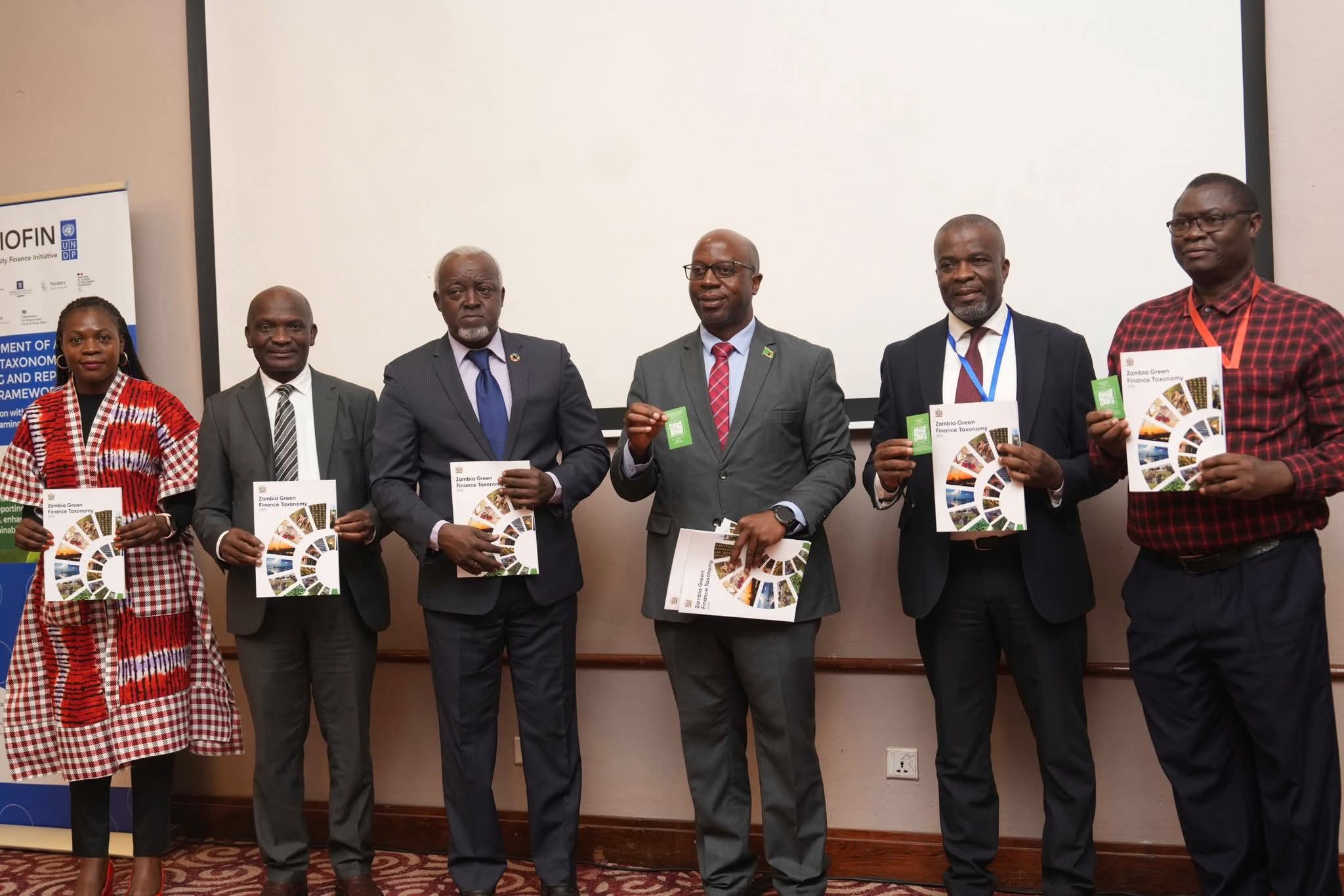
In collaboration with the United Nations Development Programme’s (UNDP) Biodiversity Finance Initiative (BIOFIN, among other like-minded partners, Zambia launched, Tuesday, the first First-Ever Green Finance Taxonomy ((ZGFT), Marking a Historic Milestone for Sustainable Investment in Africa.
The national framework, according to architectures, the strategic model, places Zambia among Africa’s frontrunners in sustainable finance. Developed through the Green Finance Mainstreaming Working Group the ZGFT establishes Zambia’s first unified, science-based system for identifying environmentally sustainable economic activities.
Launched by the Ministry of Green Economy and Environment Minister Mike Mposha, the multifaceted blueprint is envisioned to provide clear, technical screening criteria.
This will ultimately define what qualifies as green across eight high-impact sectors including energy, agriculture, forestry, mining, water, transport, tourism, and waste management.
It also sets out six environmental objectives, from climate change mitigation to biodiversity protection, ensuring investments are aligned with national and global sustainability priorities.
The ZGFT, a credible rulebook for green investments, if well executed, will enhance transparency across the financial system and limit risks of greenwashing.
It equips regulators, banks, pension funds, insurers, corporates, and investors with a common reference point to identify, assess, and report green economic activities.
The model makes Zambia join the ranks of a few African nations to develop a green finance taxonomy, joining a short list of regional pioneers advancing climate-resilient, nature-positive and low-carbon development.
The initiative, forming part of the country’s ‘2024-2030 Green Growth Strategy-will provide clear, technical screening criteria.
It will define what qualifies as green across eight high-impact sectors including energy, agriculture, forestry, mining, water, transport, tourism, and waste management.
It also sets out six environmental objectives, from climate change mitigation to biodiversity protection, ensuring investments are aligned with national and global sustainability priorities.
By establishing a credible rulebook for green investments, the ZGFT enhances transparency across the financial system and limits risks of greenwashing.
It equips regulators, banks, pension funds, insurers, corporates, and investors with a common reference point to identify, assess, and report green economic activities, illustrating the country’s resolve to promote sustainable financing.
“…..a profound statement of our nation’s intent and ambition. It positions Zambia as a regional leader in sustainable finance and strengthens our ability to build a resilient, inclusive and nature-positive economy that aligns with our national priorities and global sustainability standards” Minister Mposha said in a statement read for him by Dr. Douty Chibamba, the Permanent Secretary.
The United National Development Programme, Zambia’s key partners in fighting climate change and economic emancipation, gives a thumbs up to the country’s home grown solution arguing:
“Finance has the power to transform economic pathways, and today’s launch comes at a moment of great urgency. This taxonomy equips Zambia to channel investment into sectors that deliver resilience, long-term growth and environmental protection.”
The taxonomy is interoperable with the EU, South African, and Kenyan taxonomies, positioning Zambia competitively within regional and global markets seeking credible sustainability standards.
By providing clarity and confidence, it is expected to help mobilise domestic and international green capital, support the issuance of green bonds, sustainability-linked loans and other similar instruments, guide financial institutions in integrating environmental risks, and help accelerate private sector participation in the green economy.
BIOFIN Zambia’s financial and technical assistance has been pivotal in guiding and delivering this national framework, ensuring a coherent, inclusive, and expertly coordinated development process.
The Government, in collaboration with financial regulators and partners, will now begin national roll-out of the taxonomy.
This includes training sessions, technical clinics, and sector-specific guidance to support adoption across Zambia’s financial system.
South Africa, Rwanda, Kenya and Ghana form part of the African countries that have launched the initiative. Senegal is in the process of developing its own green finance taxonomy. It will be the first in French-speaking Africa.