
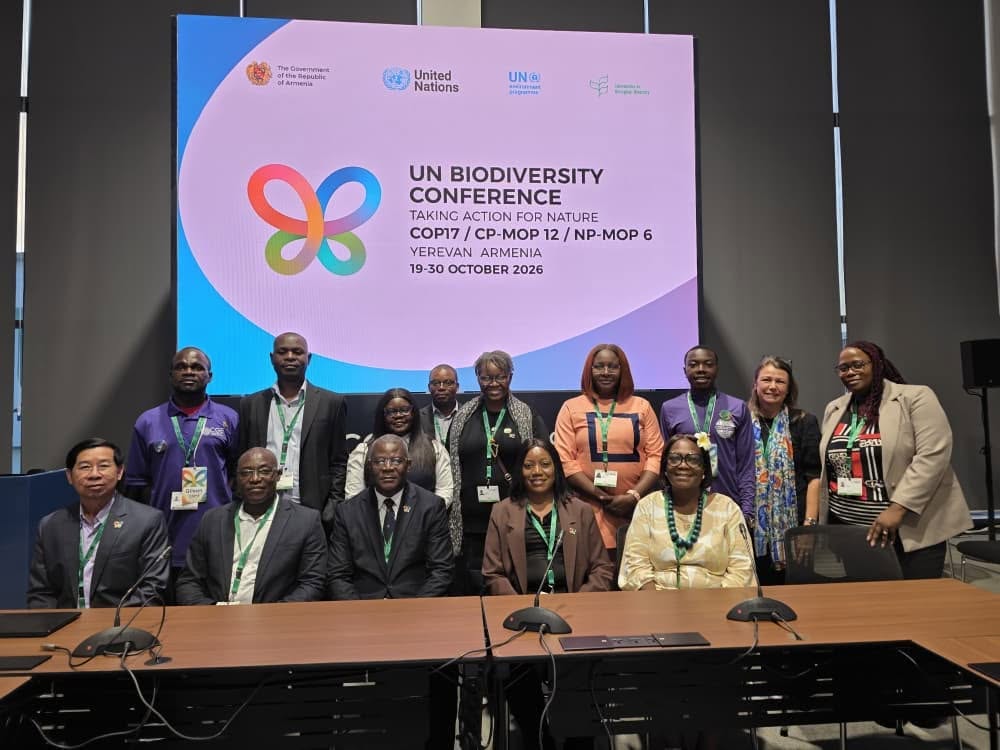
By Jeff Kapembwa
Zambia joined the rest of the world during the ongoing United Nations biodiversity conference COP17 in Yerevan, Armenia and reaffirmed its commitment to protecting and restoring rivers, lakes and wetlands as part of protection of the ecosystem amid climatic change variables.
Zambia’s Acting Permanent Secretary in the Ministry of Lands and Natural Resources and Head of Zambia’s Delegation, Kasonde Mwila stressed the importance of freshwater biodiversity for livelihoods, food security, energy security and climate resilience.
Speaking on the topic: “Unlocking Water for Cooperation: Safeguarding Freshwater@ Biodiversity and Inland Water Ecosystems under the Kunming-Montreal Framework,” during a side event, Mr. Mwila called for stronger cooperation, partnerships and investment for freshwater conservation.
In another meeting dubbed: “Mobilizing Resources for Freshwater Biodiversity: Scaling up the Freshwater Challenge,” which included the WWF Zambia and as one of the six pioneer countries of the Freshwater Challenge, Zambia further highlighted its partnership with Finland.
It also co-chaired the “Water for Cooperation” Interactive Dialogue D for the 2026 UN Water Conference in Abu Dhabi, alongside its support for the Basins for Cooperation Initiative and the 100 Parties Initiative.
As one of the pioneer countries of the Freshwater Challenge, Zambia has an important opportunity to continue demonstrating how national leadership, government action and strong partnerships can turn global freshwater commitments into results for people and nature.
Together with partners, WWF Zambia continues to support efforts that turn global biodiversity commitments into tangible results for people and nature.
Meanwhile Governments and other interest groups meeting in Yerevan, Armenia, for the United Nations biodiversity conference have made landmark decisions in seeking to protect nature and humanity with a call to actualise commitments into action in a quest to counter climate change effects.
The meeting, (formally the Conference of the Parties, or CBD COP) is to halt and reverse global biodiversity loss, protect Earth’s ecosystems, and guide humanity toward living in harmony with nature by 2050.
Drive Political Commitment: Bring together heads of state, governments, and leaders to elevate nature conservation to the same level of global urgency as climate change. It seeks to mobilise resources to help develop nations and local communities fund conservation projects.
It recognises and integrates the rights, traditional knowledge, and stewardship of Indigenous Peoples and local communities, who protect the vast majority of remaining biodiversity.
It is envisaged to connect ecosystem protection with human survival, food security, clean water, and the broader UN Sustainable Development Goals (SDGs).
The players, welcome the growing global mobilization for biodiversity in recent years, while recognizing that the first global report on the implementation of the Framework demonstrates that collective efforts and progress remain insufficient and that accelerated implementation is urgently needed.
The delegates agreed to seek to transform commitments into measurable actions and lasting results at all levels.
It was resolved that all should commit to strengthening national implementation through whole-of-government and whole-of society approaches, including through integrated planning, effective environmental governance and sustained political leadership.
There is greater need to enhancing the effective conservation, restoration, management and sustainable use of terrestrial, freshwater, coastal and marine ecosystems, including ocean and mountain ecosystems.
This is, progressively raising ambition and accelerating action where collective progress remains insufficient, mainstreaming biodiversity across public policies and economic sectors and promoting policy coherence.
This is in support of the 2030 Agenda for Sustainable Development, in accordance with national circumstances, priorities and capabilities
Underline the need for mobilization of increased, adequate, predictable, timely and accessible public and private finance for biodiversity from all sources, including by creating fiscal space through putting in place catalytic incentives for nature-based solutions and/or ecosystem-based approaches,.
Others are through strengthening capacity-building, scientific and technical cooperation, access to and transfer of technology, and innovation.
This is done, while enhancing international partnerships and cooperation to support implementation in developing countries, in particular the least developed countries and small island developing States among them.
Commit to strengthening monitoring, planning, reporting and review, improving biodiversity data and knowledge systems, promoting science-based decision-making and the responsible use of innovative technology.
It also recognises the traditional knowledge, innovations and practices of indigenous peoples and local communities with their free, prior and informed consent, as appropriate.
The meeting called for strengthening the meaningful, full and effective participation and contributions of indigenous peoples and local communities, women, youth, subnational governments, cities and other local authorities, academia, civil society.
Others are the business and finance community and other stakeholders to push for the achievement of the 2030 mission and targets of the Kunming-Montreal Global Biodiversity Framework.
Commit to promoting and incentivizing sustainable production and consumption patterns and approaches that contribute to halting and reversing biodiversity loss across all sectors of economy and finance.
Underscore the need to step up efforts to ensure the fair and equitable sharing of benefits from the use of digital sequence information on genetic resources, including through the Multilateral Mechanism for the Fair and Equitable Sharing of Benefits from the Use of Digital Sequence Information on Genetic Resources, Including the Cali Fund.
Emphasised the importance of maximizing synergies and improving policy coherence among the Rio conventions, other multilateral environmental agreements and the wider United Nations system in support of more effective and efficient implementation of the Framework and associated environmental commitments.
The 17th meeting of the Conference of the Parties (COP 17) to the Convention on Biological Diversity (CBD) place in October 2026 Yerevan, Armenia.
It was held conjunction with the twelfth meeting of the Parties to the Cartagena Protocol on Biosafety (CP-MOP-12) and the sixth meeting of the Parties to the Nagoya Protocol on Access and Benefit-sharing (NP-MOP-6).
COP 17 will mark the first global review of collective progress towards the implementation of the Kunming-Montreal Global Biodiversity Framework (KMGBF).