
By Jeff Kapembwa
An estimated 1.2 million people in Zambia face acute hunger between October and March next year spurred by extreme weather patterns threatening food, environmental and human security, a call for sustained joint efforts to cushion the effects.
With authorities calling for contingency measures to assist adapt and remain resilient to the impending El Nino, deemed more severe than before, Secretary to the cabinet, Patrick Kangwa challenged all players to be pro-active unlike reacting to the disaster as forecasted by meteorological weather assessments until early 2027.
Reeling from the 2023-24 El Nino induced disaster that afflicted various sectors, prompting Zambia to seek aid-worth US$23 billion from the international community, Kangwa seeks actionable contingency measures with a call for early action and climate resilience.
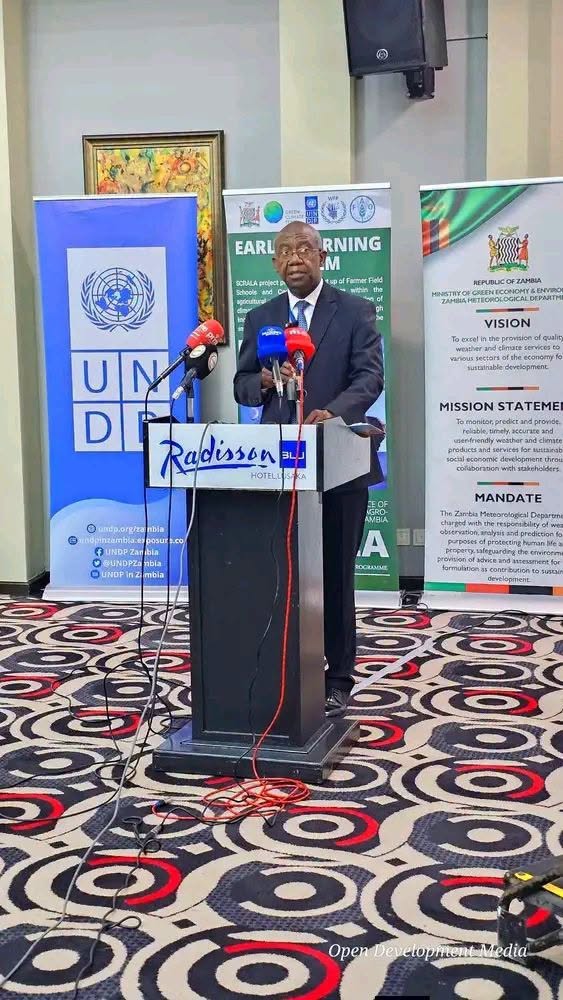
Launching the Zambia Launches 2026/2027 Rainfall Forecast in Lusaka, Friday, Kangwa, called for experts to take centre stage in preparing the minds of all potential victims.
Varying rainfall patterns require the country to shift from reactive disaster response to proactive preparation, arguing: “Waiting for disaster to strike is no longer an option, but to start preparing for them,”
Meteorological data shows that the Northern Belt is expected to receive normal to above-normal rainfall, while parts of the Central region may experience normal to below-normal rainfall later in the season.
The Southern Belt is expected to record below-normal rainfall, with a delayed onset of the rains, a challenge for farmers that may be deprived of information on how to counter the crisis.
Kangwa directed various line ministries, provincial administrations and local authorities to initiate contingency plans in place as adduced from the forecast, whose information should guide planning in agriculture, food security, water, energy, health and disaster risk management.
Planners, extension officers, decision-makers and communities should now act to the early warnings from the forecast and translate their mitigating actions into practical action as ‘waiting for climate disasters to strike is no longer an option but mandatory.
The call to action comes as the Ministry of Green Economy and Environment targets over one million farmers across the country with timely climate advisories to help them mitigate production risks during the 2026/2027 farming season.
The government remains an active player in the impending recurrence of the climate crisis and will prioritise early-maturing and drought-tolerant crops in drier areas. Farmers in wetter areas should remain alert to water logging.
The pro-active actions are expected to improve productivity, strengthening resilience, supporting food security and protecting rural incomes.
Permanent Secretary at the Ministry of Green Economy, Dr. Douty Chibamba called for timely climate data through the advisories to assist farmers plan activities to cushion the impact of the El Nino induced disaster.
Ministry of Agriculture and the Disaster Management and Mitigation Unit, are on high alert and are devising multiple actions including digital climate advisory services, among other to translate complex weather information into practical guidance for farmers.
The United Nations Resident Representative to Zambia, James Wakiaga stressed the call for resilience building ahead of the impending El Nino which threatens food security.
The UN commends the Government’s pro-active stance to mitigate the El Nino as forecast with a call for various growth sectors to initiate immediate emergency contingency plans, heavily reflecting on the difficult lessons learned during the historic 2023/2024 drought.
The UN, through various units has been instrumental in assisting Zambia in various climate change mitigation initiative including the recent upgrade in the country’s meteorological framework.
Recently, the UN through the World Food Programme (WFP) collaborated with the Zambian government and the UK Met Office and rolled out a $3.6 million climate monitoring project.
WFP Country Director Cissy Kabasuuga called for “accurate weather observations to help improve early warning systems, anticipatory action measures, and food security interventions”.
The UNDP further published a targeted National Human Development Report titled “Dialing Back: Overcoming the Threat Multipliers of Climate Change and Variability,”.
The advocacy was a call to Zambia to initiate an integrated policy framework to protect rural livelihoods from erratic weather cycles.
The African Union, during a recent El Nino preparedness meeting in Zambia, in collaboration with African Centre of Meteorological Applications for Development (ACMAD) officially opened the Twenty-First African Continental Climate Outlook Forum (ACCOF-21).
It, challenged the continent to be alert and urgently strengthen disaster preparedness and early-warning systems for an anticipated 2026/2027 El Niño event projected to be the strongest since 1950.
Earlier, the AUC during an emergency ministerial meeting in Addis Ababa, warned that the weather pattern carries a greater than 90% likelihood of severe manifestation. The phenomenon threatens to trigger severe droughts, intense heatwaves, and widespread floods across various parts of the continent.
During the continent meeting dubbed: “Strengthening Readiness to Anticipate and Manage Climate Shocks”, the World Meteorological Organisation’s Africa regional director, Dr. Agnes Kijazi, emphasized their commitment to providing actionable hydro meteorological data to save lives.
According to WMO predictions, Africa faces an “exceptionally high likelihood of nearly 100%” that this intense El Niño cycle will persist through February 2027.
The meeting brought together African meteorologists, regional economic communities, and humanitarian bodies to establish a harmonized continental weather outlook.
It produced a critical Policy Brief to guide leaders in safeguarding climate-sensitive sectors like agriculture, water resources, public health, and energy.