
By Happy Mulolani
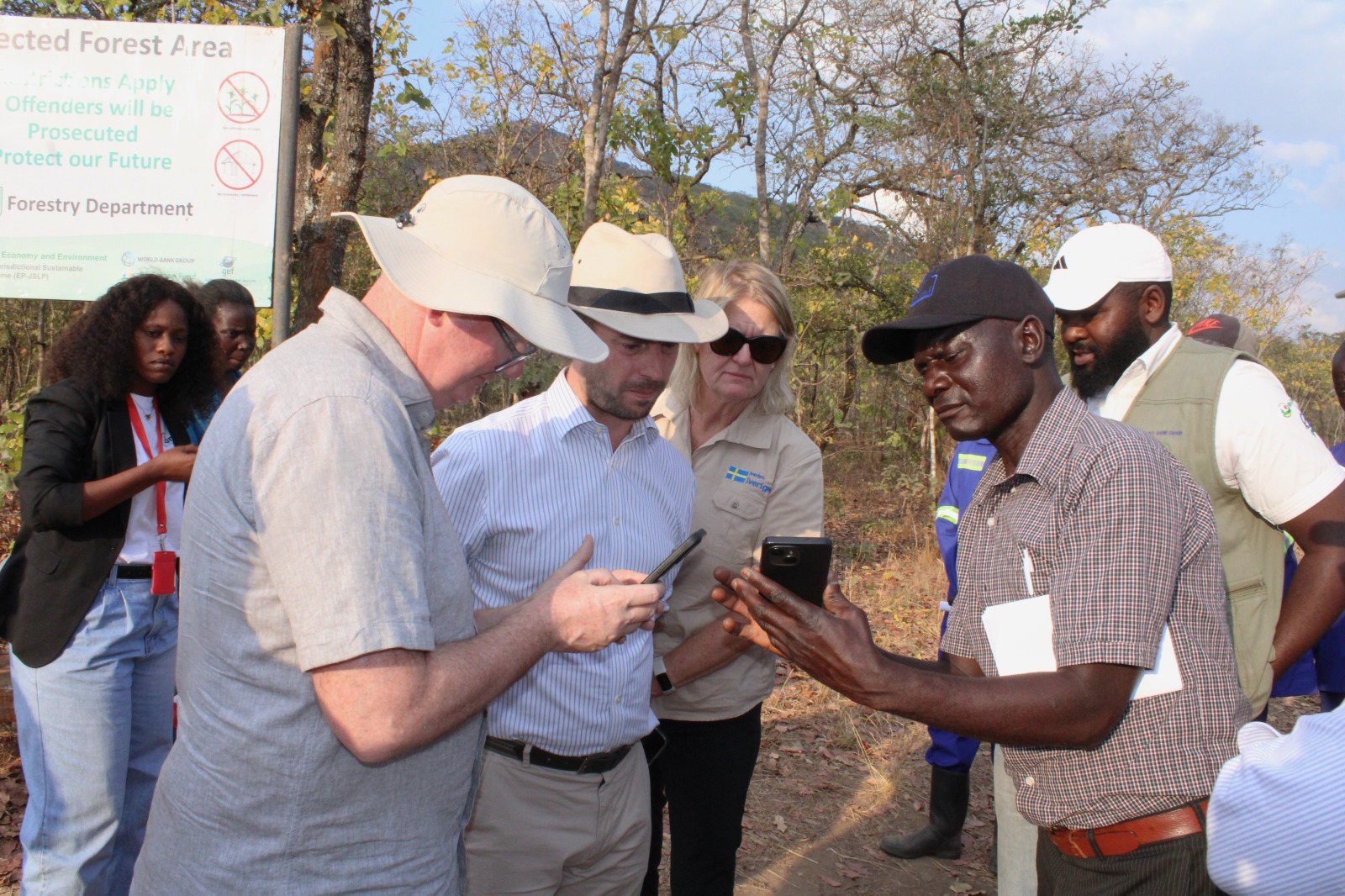
As efforts to boost Climate-Smart Agriculture and Community Forest Management (CFMG) continue in various communities, a recent visit by European diplomatic missions, government and development partners was undertaken in the Eastern province to witness how interventions were bearing fruit in selected farmer communities.
The delegation included; Simon ten Brinke-Jakcson, British Deputy High Commissioner to Zambia Vincent Maher, Deputy Ambassador at the Embassy of Ireland in Zambia, Deputy Head of Mission and Head of Cooperation at the Embassy of Swedeny, and Deputy Ambassador at the Embassy of Germany in Lusaka, Andreas Pletziger. The team was accompanied by EP-JSLP Project Coordinator Noel Muchimba, Acting Katete District Commissioner Paul Ngongolo and other officials.
The delegation specifically visited Katete district which is one of the districts under the Eastern Province Jurisdictional Sustainable Landscape Programme-Emissions Reduction Project (EP-JSLP).
The EP-JSLP is implemented by the Government of the Republic of Zambia through the Ministry of Green Economy and Environment, with support from the World Bank, while Climate-Smart Agriculture interventions are implemented through the Ministry of Agriculture.
The field tour was organised by Eastern province GIZ Agri-Food Cluster and Climate-Smart Agriculture and Agroforestry Farmer Field School in Dole and the Chiswa Community Forest Management Group (CFMG).
The visit to Katete focused on how local farmers and communities were adapting to climate change as well as enhancing their landscapes and boosting their livelihoods.
A lead farmer at Dole Farmer Field School, Stanley Mbewe, showcased some of this success of innovative climate practises which he was making use of in his agriculture practises. Mr Mbewe unpacked the climate smart agriculture and agroforestry techniques, like Leucaena and Gliricidia plants, irrigation methods, metal silos, and household biogas production.
Speaking during the high delegation visit, Mr Mbewe was grateful for EP-JSLP’s support in offering trainings and resources. “These efforts are significantly enhancing food security, livelihoods, and resilience against climate change,” Mr Mbewe said.
One of the beneficiary farmers, Solobati Phiri, testified how he had adopted Climate-Smart practices. Ever since, he acquired the necessary training and resources, there were positive changes in his farming practises.
In another visit to the Chiswa Community Forest Management Group, Chairperson Sekelani Banda, explained how the group is actively participating in fire management, boundary marking, forest restoration, and sustainable livelihood initiatives on the 613 hectares of forest.
Speaking during the visit, British Deputy High Commissioner to Zambia Simon ten Brinke-Jackson hailed farmers for their adoption of Climate-Smart Agriculture in their farming practises and called for further adoption of successful methods. He stated, these interventions should be replicated to other peers.
“The vital role that community Forest Management Groups play in sustainable forest management, landscape restoration, and reducing emissions in Eastern province,” EP-JSLP Project Coordinator Noel Muchimba emphasized.
EP-JSLP has so far supported 220 beehives. These bee hives provide an income and also promote forest conservation.
Following the field visits of both Chiswa and Dole Farmer Field School models, Vincent Maher, Simoon ten Brinke-Jackson, and Andreas Pletziger was impressed with the positive strides of both sustainable forest practices, highlighting the significance of forest regeneration and community involvement and practical conservation agriculture.
Lessons learnt reflect how farmers have been equipped with appropriate knowledge and practises. Their adoption so far shows the efforts and also reveals the level of forest resources and enhancing sustainable management.
The impressions of the European Development partners is that local communities are empowered and champion climate-smart agriculture and sustainable forest management in their communities. The discussions reinforce the collective commitment of the government and its partners to tackle climate resilience, promoting sustainable agriculture, restoring forests, and supporting community-led livelihoods. It is very critical to enhance knowledge-sharing and also adopt effective strategies.