
By Jeff Kapembwa
Campaigners against climate change are meeting in Lusaka, the Zambia’s capital, to strategise against the impending El Nino, threatening the continent’s ecosystem, prompting a call for action.
The two-day jointly organized 21st Twenty-First African Continental Climate Outlook Forum (ACCOF-21), strategic dialogue themed: “Preparing Africa for El Niño 2026/2027: Strengthening Readiness to Anticipate and Manage Climate Shocks” under the auspices of the African Union Commission is underway to ultimately strengthen Africa’s preparedness for the forecast 2026-27 El Niño.
With Africa’s experience of similar climate-driven El Nino induced shocks in recent years, frustrating human habitat and heightening food insecurity, the campaigners against climate change seek to strategies and allow Africa to share information timely as a countervailing measure.
Permanent Secretary in the Ministry of Green Economy and the Environment Douty Chibamba challenged Africa to be pro-active in mitigating the effects of the climate change by securing essential equipment heightened information sharing to hasten sustainable development.
He called for early action to protect the continent and its inhabitants against El Nino and other induced temperature related headwinds. He challenged weather experts on the continent to take a front role in strengthening collaboration, share scientific knowledge, harmonize climate outlooks, among others.
Such modalities are essential for the continental climate-sector working groups, and will further strengthen the continental user interface platforms that connect the producers of climate information with those who use it as a yardstick to foster resilience.
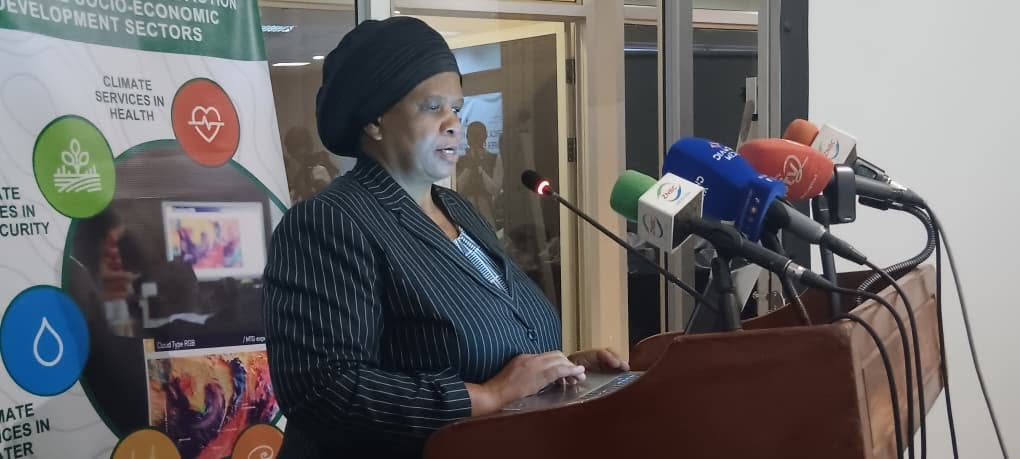
“Africa continues facing severe climate challenges placing the need of climate information as an essential resource for sustainable development. However, climate information only creates value when it is translated into action.” Dr. Chibamba is cited as saying during the meeting in a statement read on his behalf by Mr. Ranford Simumbwe, the MGEE director for human resource.
The Dialogue is being facilitated through the African Union’s Climate Services (ClimSA) Programme with financial support from the European Union, attracting climate experts, disaster management institutions, humanitarian actors, sector representatives, and the media to strengthen Africa’s collective preparedness for the anticipated El Niño event expected from 2026 into the following year and is forecast to impact heavily.
Dr. Ousmane Ndiaye, Director General of the African Centre of Meteorological Applications for Development (ACMAD) warning against complacency with the looming El Nino, noting its devastating impact across the continent, urging all be proactive by maximizing on information sharing.
“With the looming El Niño 2026/2027 and its potential impacts across Africa, we cannot afford to wait before acting” Dr. Ndiaye is cited as saying in a statement. Under the 21st Africa Continental Climate Outlook Forum, African countries are privy to information that strengthens their preparedness, and translates climate information into timely action.
The African Union Commission (AUC) urged Africa to focus towards anticipation, preparedness, and early and coordinated action to protect lives, livelihoods, economies, and critical infrastructure.
He challenged Africa to step up its preparedness for the impending El Nino and other climate shocks by being pro-active.
Harsen Nyambe, the Sustainable Environment and Blue Economy Director, in a statement on behalf of the Commissioner for Agriculture, Rural Development, Blue Economy and Sustainable Environment called for a shared commitment to mitigate El Nino, whose impact is not selective, but devastating
“Climate shocks do not respect borders, sectors, or communities. Our response must therefore be collective, coordinated, and proactive.”
Recent El Niño events have demonstrated the significant impacts climate shocks can have across the continent. Droughts, floods, food insecurity, water shortages, disease outbreaks, and disruptions to energy systems continue to affect millions of Africans.
Regrettably, vulnerable communities, particularly women, children, smallholder farmers, pastoralists, and coastal populations, often bear the greatest burden. WMO Regional Office director for Africa, Dr. Agnes Kijazi, called for the development of coordinated continental climate outlooks.
There is greater need to strengthen collaboration between climate information providers and sector users, improved early warning communication, and enhanced preparedness planning in key priority sectors such as agriculture, food security, water, health, disaster risk reduction, and humanitarian response. Messages from Director,
“The increasing likelihood of El Niño conditions extending into 2026–2027 underscores the urgent need for Africa to strengthen preparedness, anticipatory action, and climate-informed decision-making.
Through the African Continental Climate Outlook Forum, countries are working together to translate climate science into practical early warning services that protect lives, livelihoods, and economies.
WMO reiterates its resolve to supporting the African Union Commission, Regional Climate Centres, and National Meteorological and Hydrological Services in delivering accurate, accessible, and actionable climate information that enables communities and governments to anticipate and manage climate risks effectively.”
The WMO envisions that working with the climate experts and sector institutions is key to ensuring tailored weather and climate information is translated into practical guidance for decision-makers and communities.
This will ultimately help move climate information from technical reports into real-world actions that support resilience and sustainable development across Africa.
The Dialogue underway in Lusaka demonstrates Africa’s commitment to strengthening continental cooperation.
It further strives to ensuring that climate information reaches those who need it most, in an adequate, timely, understandable, and actionable manner.
The ClimSA organized 2-day-Lusaka indaba, is EUR 22 million AU flagship initiative.
It seeks to close the climate information services gap in African, Caribbean, and Pacific (ACP) countries enhanced integrated, end-user-oriented climate services across sectors such as agriculture, health, energy, water, agriculture and disaster risk reduction.
Advocates of Climate change describe El Nino an occurring climate phenomenon spurred by the warming of sea surface temperatures in the central and eastern tropical Pacific Ocean.
It further alters global atmospheric patterns, triggering widespread droughts, floods and others, and above-average temperatures.